English
 Español

Appli Parts Vacuum Pumps: How to Choose Between 3, 7, and 14 CFM for Your HVAC/R System
Pulling a vacuum is one of the most critical — and most rushed — steps in any HVAC/R installation or service call. An incomplete evacuation leaves moisture and non-condensable gases in the system, leading over time to internal corrosion, inaccurate pressure readings, and premature compressor failure. The right vacuum pump isn't the biggest one in your truck: it's the one that reaches the required vacuum depth in the right amount of time for the system you're working on.
Appli Parts, available at Galpa, offers three models covering everything from residential service technicians to commercial and industrial system specialists. Here's how to choose the right one.
What all three models share
Before diving into the differences, it's worth highlighting what all three have in common — because these are the features that define field performance:
-
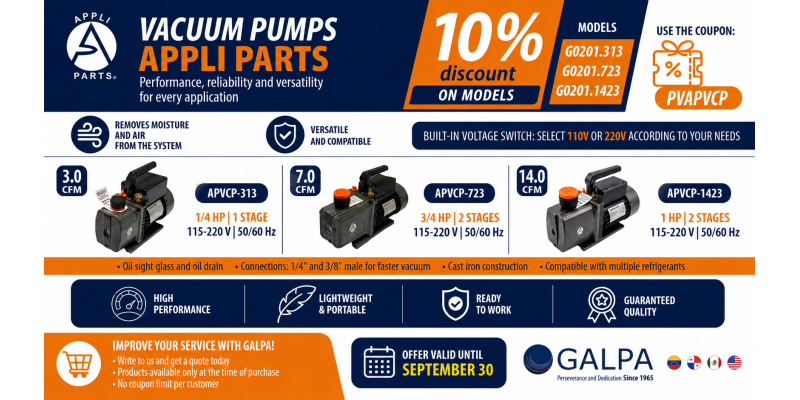
Built-in voltage switch: manual selection between 110V and 220V on the same unit, no transformer needed. Particularly useful when working across markets with different electrical standards (US, Central America, South America).
-
Oil sight glass and oil drain: check oil condition without disassembling the pump, and change oil easily in the field — critical for maintaining vacuum depth over time.
-
1/4" and 3/8" male connections: compatible with most standard manifolds on the market without additional adapters.
-
Cast iron construction: better durability and heat dissipation compared to thin aluminum or plastic housings.
-
Compatible with multiple refrigerants: R-22, R-410A, R-404A, R-32, R-134a, and more.
Model comparison
| APVCP-313 | APVCP-723 | APVCP-1423 | |
|---|---|---|---|
| Flow rate (CFM) | 3.0 CFM | 7.0 CFM | 14.0 CFM |
| Motor | 1/4 HP | 3/4 HP | 1 HP |
| Stages | 1 stage | 2 stages | 2 stages |
| Voltage | 115-220 V | 115-220 V | 115-220 V |
| Frequency | 50/60 Hz | 50/60 Hz | 50/60 Hz |
| Best for | Small residential systems | Mid-size, commercial split | Commercial & industrial systems |
What "stages" means in practice
A single-stage pump compresses gas once before expelling it. A two-stage pump compresses it twice in sequence, reaching significantly deeper vacuum levels — typically below 15 microns, versus the 75-150 microns a single-stage pump reaches under optimal conditions.
For systems running modern refrigerants like R-410A or R-32, which are more sensitive to moisture contamination, the deeper vacuum of a two-stage pump isn't an optional upgrade — it's a technical requirement.
How many CFM do you need?
Flow rate determines how quickly you reach the required vacuum level. A widely used industry rule of thumb: 1 CFM per ton of refrigeration capacity, with a minimum of 3 CFM for any job.
-
APVCP-313 (3.0 CFM, 1 stage): ideal for residential mini-splits, window units, and systems up to 2-3 tons where evacuation speed is not critical.
-
APVCP-723 (7.0 CFM, 2 stages): the most versatile model in the lineup. Covers commercial split systems, units up to 5-6 tons, and any application where deep vacuum with reasonable evacuation time is needed.
-
APVCP-1423 (14.0 CFM, 2 stages): for larger systems, multiple circuits, or when field service time is an economic factor. At 14 CFM, what the 3 CFM pump does in 40 minutes, this one handles in under 10.
Limited-time offer — valid through September 30, 2026
For a limited time, get 10% off on models APVCP-313, APVCP-723, and APVCP-1423 using coupon code PVAPVCP at the time of purchase. No coupon limit per customer; applies only to products available at time of purchase.
All three Appli Parts vacuum pumps are available now at Galpa. Contact us at galpaexport.com to get a quote today.